
Stop Hoping Nothing Bad Happens. Start Knowing You Can Handle It If It Does
Because The World Doesn't Care That You Weren't Ready!!
You Don't Have To Be A Fighter. You Just Have To Be A Harder Target
Violence won’t wait for the right moment or for you to be ready. If you’re in Huntersville, Cornelius, or the Lake Norman area, it’s time to get ready before you need to be.
Violence doesn't care that you've never been in a fight, that you're in your fifties, or that nothing bad has ever happened to you before. What it cares about is whether you've done anything about it.
Whether you want to protect yourself, your family, or just feel unshakable in any situation, this is where you start.
Who's The Instructor?
Nick Hughes has spent most of his adult life dealing with real-world violence, not the theoretical kind.
He served in the French Foreign Legion's parachute regiment, where he taught unarmed combat. After the Legion he worked worldwide as a professional bodyguard for members of the Saudi royal family, VIPs, and rock stars.
He's been teaching self-defense for over forty years and is one of the very few Krav Maga instructors in the US with actual military experience. He has boxed professionally, is the author of the critically acclaimed "How To Be Your Own Bodyguard," and holds black belts in various styles of Karate, as well as Judo, Aikido, and Jujutsu.
Why Residents of Lake Norman Choose Krav Maga LKN
Located on Old Statesville Rd next to the new Aquatic Center, makes for easy access from Cornelius, Huntersville, Davidson, Denver, Mooresville, and Charlotte.
Whether it's for you or your teenager, we have classes for both. We also have classes in the devastating Filipino martial art of Kali if learning weapons is more your speed.
Adult classes are for men and women aged 18 and above, while the teen classes are for those aged 12 to 17.
Both focus on real threats, rather than sport, tournaments, or tradition.
There are no forms or pajamas either.
The instructors, professionals trained in how to cope with non-consensual violence, have only one goal. To make you more dangerous so you're less likely to ever be chosen as a target.
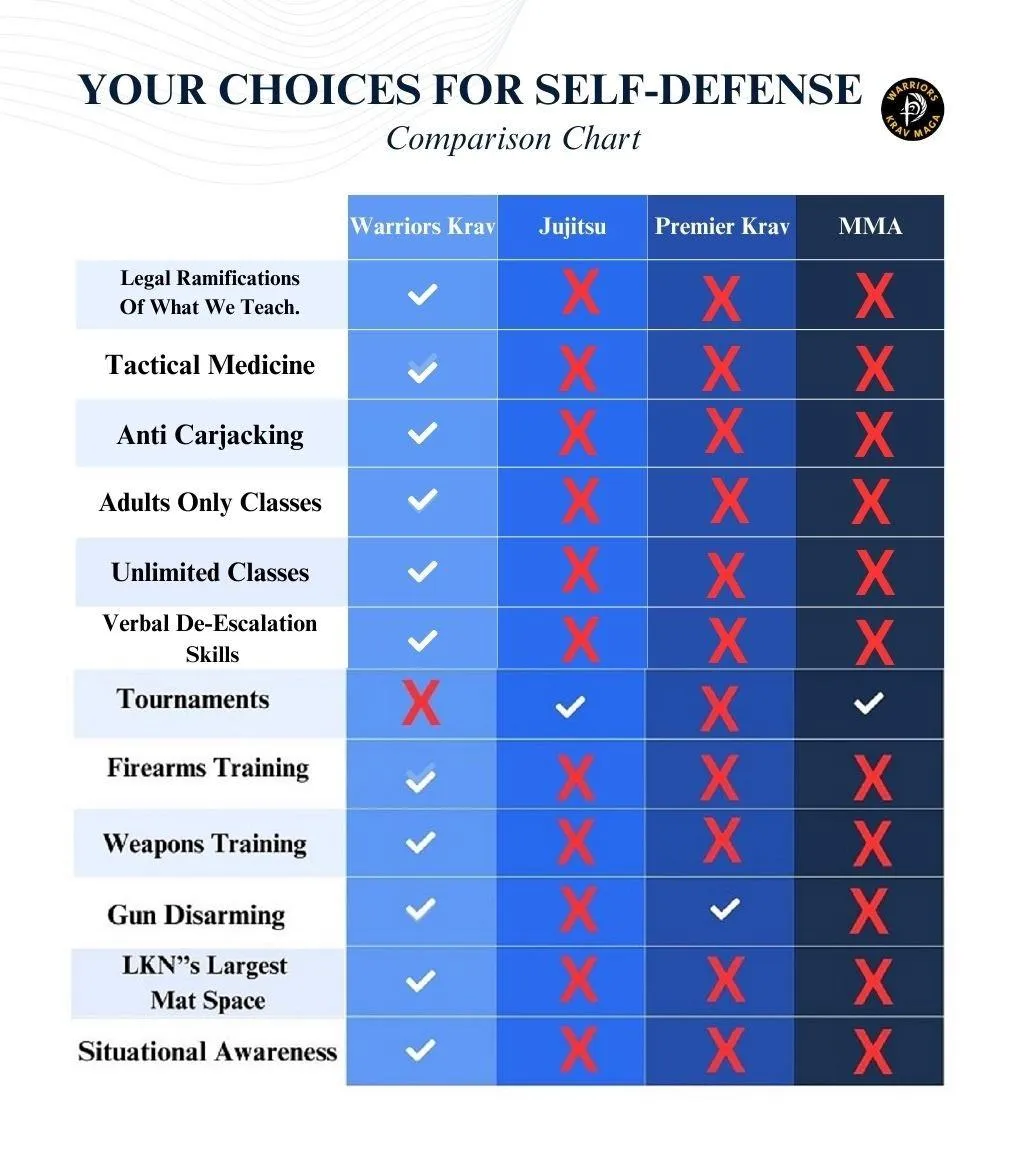
See the comparison chart below to see exactly what we mean.
Pre-Attack Cues Every Criminal Does Unconsciously
One of the problems you have is being able to distinguish between a genuine inquiry when someone approaches you, and a potential setup by a criminal.
At Krav Maga LKN, we'll teach you the four pre-attack indicators that criminals do, unconsciously, before they attack someone. That way, you'll have a massive head start should you become involved in a potential attack.
What others are saying
"Love It"
“Every single class you will learn something useful. Well into my 50’s I’m in the very best shape of my life. I’ve learned to recognize and avoid danger and defend myself if I need to. I can’t say enough about the workouts, & the club.”
Donna E.


"Real World Experience"
“Nick has many talents from his years in the trenches. Real-world experience that he can call on to teach us the best way to deal with adverse situations.
He is not like a lot of other so-called instructors who only teach theory. I am a 57-year-old male with total hip replacement so if I can do this, anyone can.”
Tom Norment

"Very Knowledgeable"
Very knowledgeable instructors who focus on practical self-defense that anyone can learn, regardless of age and ability.
Very welcoming environment.
William Cain
Frequently Asked Questions
Is It Safe?
Yes, it's safe.
In over 30 years of teaching, we’ve never had a serious accident in class. Of course, we’re learning to deal with non-consensual violence, so there will occasionally be bumps and bruises along the way. We like to call them “Krav Kisses.”
For context, Krav Maga doesn't appear in the top 50 most dangerous sports in the world. Horseback riding, cheerleading, and gymnastics all rank in the top five here in the US. FYI, here's a link to the top 15 most dangerous sports.
Do I need any prior experience to join your classes?
No, prior experience is not required.
Our classes are suitable for all skill levels, from beginners to advanced practitioners. Our instructors provide personalized guidance to help you progress at your own pace, regardless of where you're starting from.
What should I wear to my first class?
Wear comfortable athletic clothing and trainers.
We supply everything else you need during your trial period.
How do I sign up for a membership or schedule a class?
You can schedule your two-week paid trial through our website's registration page, or simply click the orange "Trial" button located on every page.
Alternatively, you can reach us through the contact page.
Is There An Age Limit?
Yes. Our adult classes are for those eighteen and over. There's no upper age limit, though if you're over 40, we recommend getting your doctor's okay.
Our Teen Self-Defense classes are for 15 to 17-year-olds.
Can I Start Anytime?
Yep. Click on the button below and schedule your first session.
Do I Have To Be In Shape?
No. That’s like asking if you must be flexible before joining a yoga class.
We will get you in shape while you’re learning self-defense. Most people don't even notice the workout because it's built into the lesson.
That said, we highly recommend that if you’re over 40, you get your doctor’s approval.
We also want everyone to know that when you join, if you need to take a break during class, you take one. No need to ask for anyone’s approval. After the first month, we rarely find anyone who needs the break again.
How Long Before I See Progress?
That depends very much on the individual.
Some people pick things up quickly, usually because they played a lot of sports when younger and developed coordination. Other people take a little longer. It doesn’t really matter as long as you’re progressing.
We want you to walk out of every class a little more knowledgeable about the subject of self-defense and a little more dangerous. As long as you’re doing that, we’re happy.
Because we’re not preserving a classical art form, you will progress much faster than in a traditional martial arts school.
Are There Belts?
No belts. We use colored t-shirts to denote rank.
Everyone starts in an Ash Gray shirt. From there, it's a blue shirt. The next is tan, then red, then steel gray, and finally black. There are six levels of black shirts in the system.
Are There Any Women In The Class?
Yes.
Women make up roughly 40 percent of the class. Obviously, they’re very concerned about self-defense, but Krav Maga also suits women because it uses simple, effective, and aggressive techniques.
You can check some of them out on our Instructor's page.
What Is Krav Maga?
Krav Maga is a practical, real-world self-defense system developed for the Israeli military.
It’s designed to be easy to learn and highly effective under stress. It deals with multiple attackers, active shooters, carjackings, and weapons. Unlike BJJ and MMA, we're not concerned with rules or referees.
Is It Good For Beginners?
Absolutely.
Many of our students had no martial arts or self-defense experience before starting. We’ll guide you every step of the way. Our beginner classes are separate from our advanced so you progress even faster than schools that combine the two.
FOLLOW US


18339 Old Statesville Rd, Unit i
Cornelius, NC 28031
COMPANY
CUSTOMER CARE
ADMIN
GET FIT
HAVE FUN
LEARN SELF-DEFENSE
Copyright 2026. Krav Maga LKN. All Rights Reserved. Tel: 704-299-0681