WHAT AGE SHOULD MY CHILD START SELF-DEFENSE CLASSES?
The Honest Answer
It's one of the most common questions I get asked whenever I talk to a parent at a party or a networking event. "Is my child old enough? or, "Is my child too young?"
Sometimes I sense they're asking me because something has already happened. A run-in with the school bully, a scare on the way home, or just a sense that something is wrong. Other times, they're asking because they're being pre-emptive. They don't want to wait until something happens, which may end up scarring the child for life. (That's great parenting by the way. Acting proactively is definitely the way to go.)
Either way, it's a great question to ask, because, when it comes to real self-defense training, not just tumbling around on the mats playing games, age and comprehension matter quite a bit.
So, go grab a coffee, and I'll tell you the answer.
The Short Answer
I start them in my school at age eight because that's the age I began my martial arts journey, with the school Judo and Jujutsu club. Later on, I'd see clubs starting them at six, but I could tell by watching a lot of those kids that they had no idea what was going on.
It's a fact of life that some six-year-olds act like ten-year-olds, and some ten-year-olds act like they're six.
I'll talk later about the 3 and 4-year-old classes, and whether they're any good or not, but for now, let's talk about the 8-year-old mark and why it's good, other than the fact that's when I started.
That number 8 is grounded in child development research, and it's an age that produces great outcomes for understanding what's going on and grasping the concepts.
What Does The Research Say About Child Development?
Jean Plaget, one of the most-cited developmental psychologists in history, identified a critical shift that happens around 7-8. Children move from what he called the "pre-operational stage, where thinking is largely symbolic and egocentric, into the "Concrete Operational" stage. where they can use logical reasoning, understand cause and effect, and begin to grasp that their actions have consequences for other people.
Interestingly, as a certified hypnotist, this is the age that we notice the development of what we call the "critical faculty," and even the Jesuits in the 16th century said, "Give me the child until he's seven, and I will show you the man."
In plain terms, before age 7-8, a child imitates. After that same age, the child begins to understand.
That's a crucial distinction when you're teaching kids self-defense. Kicking a pad is one thing, but understanding why you're kicking the pad is completely different.
This is why with us, they're learning about verbal de-escalation, when it's appropriate to use a technique, and what a real threat looks like.
That requires cognitive hardware that simply isn't fully online in most five-year-olds.
Research from the NCBI confirms this further: quote "By around age 8, children develop the capacity for conscious self-regulation." unquote. That's the ability to manage their own responses, delay reactions, and think before acting.
This is exactly the mental skill that separates the kid who will use self-defense appropriately, and the one who'll use it impulsively.
The same research shows that conflict processing and error monitoring in the brain undergo a marked development at around age 8, which is when they become genuinely capable of the kind of in-the-moment decision-making that real self-defense requires.
Why Krav Maga Specifically Requires This Readiness
Because not all martial arts are the same. Traditional arts like Karate or Tae Kwan Do are primarily movement-based. You learn sequences like forms, practice them repeatedly, and gradually build competence.
A 5 year old can participate in a class like this reasonably well, it's structured, usually replete with gamification, and doesn't require a lot of abstract thinking.
Krav is different.
Krav Maga LKN is a reality-based self-defense system. We teach kids to:
• Assess Their Environment
•Understand Proportional Response
• Distinguish between types of threats
• Stay calm under pressure
These aren't physical skills. They're cognitive and emotional skills layered onto physical techniques.
Teaching them to a kid who isn't developmentally ready doesn't just produce poor results; it can produce wrong results. A child learning striking techniques before they have the judgment of when to use them is a liability, not an asset.
At 8, however, most kids have the cognitive and emotional foundations to genuinely absorb this kind of training. That's why our program at Warriors Krav Maga LKN begins at 8-years-old.
What About Those Schools That Take Kids Far Younger?
They exist, and some do good work. But it's worth noting what those programs actually are.
Programs (typically called little ninjas, or little dragons) are typically built around games, movement, and listening skills. There's nothing wrong with that; it can help with coordination, build body awareness, balance, and help kids get used to structured instruction.
While all that's good, it's not self-defense in any meaningful sense of the word. It's physical education and development with martial arts branding.
That's a business model, not a developmental philosophy that will actually help your kid if they are attacked. Schools that start at age 5 generate earlier enrollment and longer retention, which means more money for the school. That's the logic behind it.
If you enroll your 5-year-old expecting them to be equipped to handle a real threat, you'll be sorely disappointed. If you enroll them to burn some energy, build coordination, and get them used to following directions, that's a fair outcome.
At 8, they can do all of that and actually learn self-defense
What Your Child Will Be Ready To Learn At 8 Years Of Age
By the time your child reaches 8 years old, they're typically able to:
Follow Multi-Step Instructions without losing the plot
Understand Cause & Effect
Regulate Emotional Responses
Distinguish Between Different Types of Conflict
Absorb & Retain Technique
This is the foundation everything else is built on. Physical techniques are relatively easy. The judgment to use them takes time, and that needs the right developmental stage to happen.
The 8-12 Sweet Spot
If you have a child between that 8 to 12 age range, you're in the ideal window. Here's just a few reasons why this age range is so powerful.
They're old enough to learn real skills. The cognitive and emotional development is there. They can handle increasingly complex concepts. We're talking about things like situational awareness, verbal de-escalation, understanding predatory behavior, as well as the physical moves.
They're still young enough that parents drive the decision. This is important. A 15-year-old who doesn't want to be in class won't get much out of the training. (Eye rolls, anyone?) An 8-year-old, on the other hand, whose parents bring them consistently will build skills they carry for life.
The confidence payoff happens fast. Children in this age range respond visibly and quickly to martial arts training. Within weeks, parents notice changes. Changes in how they carry themselves, how they respond to challenges, and how they talk about difficult situations.
That's not a coincidence. It's what happens when a child discovers they're more capable than they thought they were.
The bullying years are here. Research consistently shows that bullying peaks between grades 4 and 8, which is roughly ages 9 to 13. Training your child just before this happens, and during this window, is proactive protection. Waiting until high school is reactive.
A Note On Girls
This question comes up, usually from dads asking about daughters, and the answer is the same. Having said that, the "why" deserves some special attention.
Girls face a distinct threat landscape. Social and relational bullying, such as:
• Exclusion,
• Rumor-spreading,
• Online targeting
peaks in the middle school years. Physical threats from adults are real, and sensible parents think about them constantly.

The confidence that comes from self-defense training doesn't just make a girl harder to physically overpower. It changes the way she presents herself. Her posture, eye contact, boundary setting, and willingness to speak up. Predators and bullies both select for perceived vulnerability. A girl who trains with us carries herself differently, and that matters.
Signs Your Child Is Ready
Beyond age, here are a few readiness indicators:
They can follow two or three-step instructions without constant reminders
They understand the difference between rough play and actual aggression
They can handle mild frustration without shutting down
They're able to listen to an explanation and demonstrate they understood it
They show interest in the idea (this isn't required, but it certainly helps)
Most children aged 8 will tick most of these boxes. Some 7-year-olds will too. The occasional 9-year-old might still be working on them. You know your child best, which is why I mentioned earlier that some six-year-olds act like they're ten, and some ten-year-olds act like they're six.
What We Do Differently At Warriors Krav Maga LKN
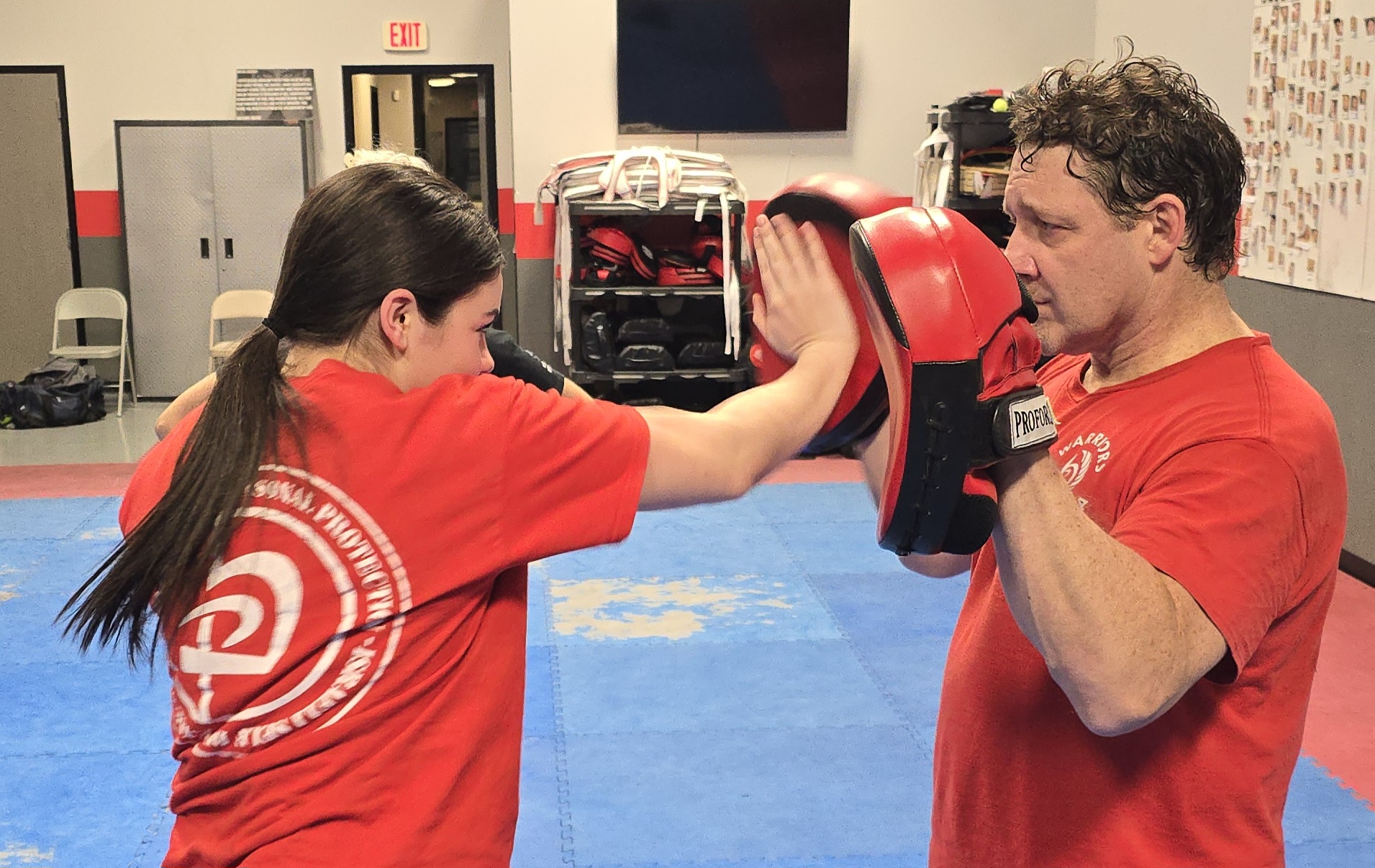
Our kids program isn't a scaled-down version of our adult classes, and it's definitely NOT a glorified playgroup.
It's a structured, progressive curriculum built specifically for children aged 8 and up and that covers:
Awareness & Avoidance: The first and best line of defense
Verbal Boundary Setting: How to be assertive without being aggressive
Physical Techniques: Age-appropriate, practical, and genuinely effective
Bully Scenarios. Peer conflict handled appropriately
Stranger Awareness. Recognizing and responding to adult threats.
Everything we teach is done in a safe, supportive environment where kids are challenged without being overwhelmed, and where the goal is always confidence first, technique second.
The Bottom Line
If your child is 8 or older, they're ready. Ready to learn skills that will serve them for the rest of their life.
If they're younger than 8, give it another year. Use that time to talk to them about awareness, boundaries, and what to do if something feels wrong. Those conversations matter too.
And, if you're not sure whether your kid is ready, come and see us. We're right here in the Lake Norman area, and we're happy to talk through whether our program is the right fit for your family, with no pressure and no sales pitch.
Is Krav Maga Safe For Kids
Yes (you can read about it here). When taught by qualified instructors in an age appropriate program. At Warriors Krav Maga Lake Norman techniques are adapted for children and taught in a controlled, supervised environment. The emphasis is always on awareness and avoidance first, and physical response only when necessary.
Will Self-Defense Training Make My Child More Aggressive?
Research and experience both say no. In fact, the opposite tends to happen. Children who train gain confidence and emotional regulation, which actually reduces impulsive or reactive aggression. They learn that they can handle themselves, which removes the anxiety that often drives aggressive behavior.
How Is Krav Maga LKN Different From Karate, TaeKwanDo, or Brazilian Ju-Jutsu?
I'm not attacking the opposition. I have black belts in every martial art that uses black belts as a form of rank and several that don't
Traditional martial arts focus on techniques, forms, and sport competition. Krav Maga is a reality-based self-defense system that teaches situational awareness, threat assessment, and practical responses to real-world scenarios. For children, this means they learn not just how to defend themselves physically, but how to think clearly in a threatening situation.
My Child Is Already Being Bullied. Is It Too Late?
It's never too late. While building confidence and skills takes time, many parents see a meaningful shift in how their child carries themselves within the first few weeks of training. We'd encourage you to reach out sooner rather than later.
What's the alternative? Let them continue to be bullied, or ship them to another school, where, within 3 months, they'll be bullied again?
What Age Does Your Program Go Up To?
Our kids program is designed for ages 8–12. From there, students can transition into our teen and adult Krav Maga classes.
FOLLOW US


18339 Old Statesville Rd, Unit i
Cornelius, NC 28031
COMPANY
CUSTOMER CARE
ADMIN
GET FIT
HAVE FUN
LEARN SELF-DEFENSE
Copyright 2026. Krav Maga LKN. All Rights Reserved. Tel: 704-299-0681